-
 Call
Call -
 Location
Saudi Arabia
-
 Email
Emailsales@rhinofloor.ae



Things to Consider Before Buying Ergonomic Floor Mats
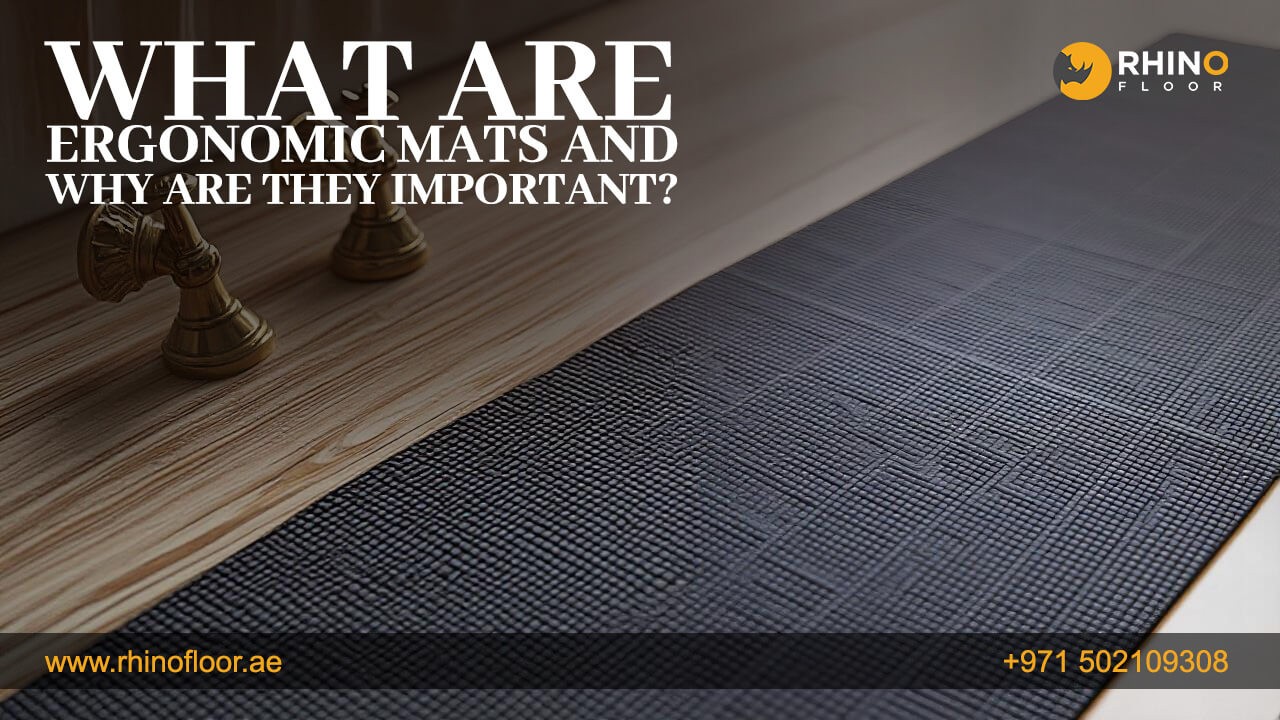
We know that work environments have become very much fast paced now. The comfort and safety of the employees matter more than anything else. If you are managing a retail store, an office or a warehouse or a factory, the people who are standing for prolonged periods of time on surfaces that are hard face real challenges. Standing fatigue can cause discomfort, lessen productivity and lead to long term health issues. This is where we find the importance of ergonomic floor mats.
Ergonomic mats are designed specially to lessen the stress and strain on foot and calf muscles and also to enhance posture and offer underfoot cushioning that will help the workers stand comfortable and be in focus with their job. The fact to understand is that not all mats are made the same. Hence prior to investing in an ergonomic floor mat at your workplace. It’s important to consider the key factors listed below to make sure that you chose the right one.
1. Understand the Work Environment
The first and foremost step is comprehending where to use the mat. The kind of environment will have a direct influence on the kind of mat you require.
-
Industrial or warehouse settings: These spaces often work with heavy machines, oil, as well as chemicals. Hence search for mats that are grease resistant, chemical resistant and abrasion resistant, with anti-slip features to prevent any accidents.
-
Commercial or retail spaces: In spaces like checkout points or reception areas, appearance matters along with usability and functionality. Hence it's important to choose ergonomic mats that go well with the decor to provide aesthetic while providing sufficient cushioning.
-
Food preparation areas: Hygiene and safety are important in these areas. Mats should be chosen in such a way that it is easy to clean, they are anti-bacterial, and are resistant to liquids.
-
Office or standing desk environments: Comfort and style are of greatest priority here. You’ll require mats with a seamless, supportive surface that will not damage the flooring or cause tripping hazards.
By making sure the mat matches with the environment, you also ensure reliability, durability, safety, and worth for the money you spent.
2. Material and Durability
Ergonomic mats come in a wide variety of materials each with its own positive aspects. The most common options include:
-
Rubber: Very good durability, resistant to slippage, good shock absorption. Suitable for industrial and wet spaces.
-
Vinyl: Chemical resistant, very easy to make it clean, but not much cushioned like rubber.
-
Foam: Very soft as well as comfortable, suitable for areas that have low impact - like office spaces or retail counters.
-
Gel: Provides premium level comfort and support for prolonged-standing periods, though at a premium cost.
For heavy-traffic areas or heavy-duty workplaces, you can select mats that are resilient and compression-resistant. A very good ergonomic mat would spring back to its original form even after long term use, offering uniform support over time.
3. Thickness and Cushioning
The comfort available in a mat greatly depends on its thickness. However, it doesn't mean that thicker mats are always the best.
-
Too thin, and it is not likely to offer sufficient cushioning to reduce fatigue.
-
Too thick, and it can cause instability and balance issues or other trip hazards.
The thickness of an ideal mat ranges from 10-25mm which is about half to one inch based on the environment. Mats that are equipped with multi layers or with high density foam cores provide the best comfort and stability. It’s always important to test or take reviews about the mat’s usage experience before making a purchase.
4. Size, Shape, and Layout
Before making a purchase, take the measurements of your workspace correctly. Mats would come in different sizes and shapes — right from single-station mats to interlocking tiles that would cover very large areas.
-
Individual mats would work well for single workers or on standing desks.
-
Modular systems are best for production lines or customised-shaped work spaces.
You need to consider the traffic flow of your workspace before making a decision. A mat that’s too big or laid in the wrong space can become a hindrance instead of a help. Many suppliers provide custom-cut mats that will fit your layout perfectly.
5. Budget and Long-Term Value
There would always be a temptation to go with the cheaper option. But in the case of ergonomic mats, you would definitely get what you paid for. There are high chances that low cost mats would wear out quickly, flatten in due course of time or fail to offer sufficient support which would lead to extra costs of replacement and also reduced safety.
Hence, it is important to think about mats as a long-term investment to the well-being of employees and the productivity of your company. Durable and high quality mats are seen to last for a longer period of time and also offer the same performance even after years thereby contributing to a good return on investment.
Conclusion: Invest Wisely for Comfort and Safety
Ergonomic floor mats are just bigger than accessories — they’re an important part of a healthy and productive workplace. The correct mat will reduce fatigue, eliminate injuries, and enhance morale, while the wrong ones could become an expensive mistake.
By considering your work area, materials, strength, safety features, and long-term value, it’s possible for you to make the right investment that will support your team’s wellbeing and enhance efficiency at the workplace . If you need any suggestions or assistance to choose the right ergonomic mat, you can contact our team at Rhinofloor and we will be happy to assist you anywhere in the Middle East.